Marek Jasaň: A Puppet Has to Feel Alive, Even When It’s Doing Nothing
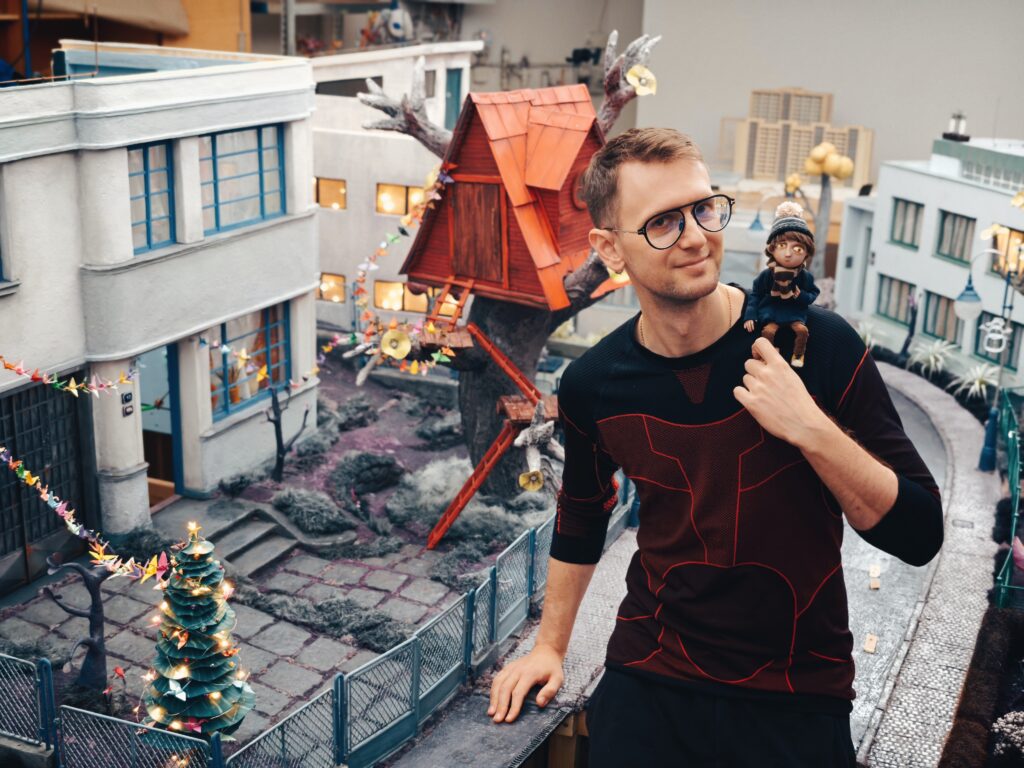
A whole day in a dark studio, hundreds of tiny movements, and perhaps four seconds of finished film. That’s pretty much what a typical working day looks like for Slovak animator Marek Jasaň. While working with puppets means having complete control over every little gesture, animating real actors brings a completely different set of challenges. Why is it sometimes harder to animate a character doing absolutely nothing than one that’s walking? And what about animation that still fascinates him? We talked about all this and much more.
They say everything starts in childhood. What was yours like?
I remember my childhood as pretty good, actually. There were three of us brothers and two cousins, so we spent a lot of time together. We played Spider-Man and other superheroes, drew our own comics. And of course, the usual sibling arguments and fights were part of everyday life.
Was anyone in your family particularly artistic?
Yes, although nobody actually made a living from art. My grandfather danced alongside his job as an engineer, my aunt is an architect, and we have a portrait of my mum hanging at home that my dad drew. So there was definitely some drawing talent in the family, and I guess that’s where I got it from.
When did you first realise you enjoyed drawing?
I remember watching my older brother draw quite a lot. Both my brothers are actually pretty good at drawing, although neither of them does it anymore. Then, sometime around fifth grade, I started taking art classes at a local art school. And that was probably the turning point for me.
What influenced you visually when you were growing up?
I read a lot as a kid, watched Marvel films and animated series on foreign TV channels. But I’m not sure I’d say any of those things really shaped me. I don’t think I’ve ever had that moment of seeing something and thinking, “Wow, I absolutely love this. This is exactly what I want to do.”
Instead, I would pick up little bits and pieces from different things I liked and try to put them together into something of my own. To be honest, I’ve never felt particularly confident as a visual artist. I was always a little jealous of classmates who had their own distinctive style. I never really had a strong visual signature that felt unmistakably mine. Some classmates claimed they could always recognise my drawings, but I suspect they just figured it out by a process of elimination. (Smiles.)
So how did you go from drawing to studying animation?
During secondary school, I got a new art teacher. She was the one who suggested I might want to study animation at university.
At the time, I was going through a pretty typical anime phase, watching anime and reading manga. She noticed that and suggested I consider studying animation.
Did the idea immediately appeal to you?
Not really. I thought it was strange. I didn’t even know you could study something like that at university. I went to a secondary school focused on maths and science, so to me, school meant studying and books. The idea of going to university to draw seemed incredibly strange, almost absurd.
But the thought was like a little seed planted in my head, and gradually it started to grow. My family was a bit shocked. They had no idea what studying animation involved or whether you could actually make a living from it. To be fair, neither did I. (Smiles.)
Did you have a backup plan?
I probably would have studied mathematics. But once I decided to give animation a try, I went all in. I was also being a little strategic about it. Entrance exams for art universities took place quite early, so I knew in advance whether I’d been accepted. If it hadn’t worked out, I might have ended up studying maths. Maybe I’d be an analyst or a statistician today. I honestly can’t imagine it.
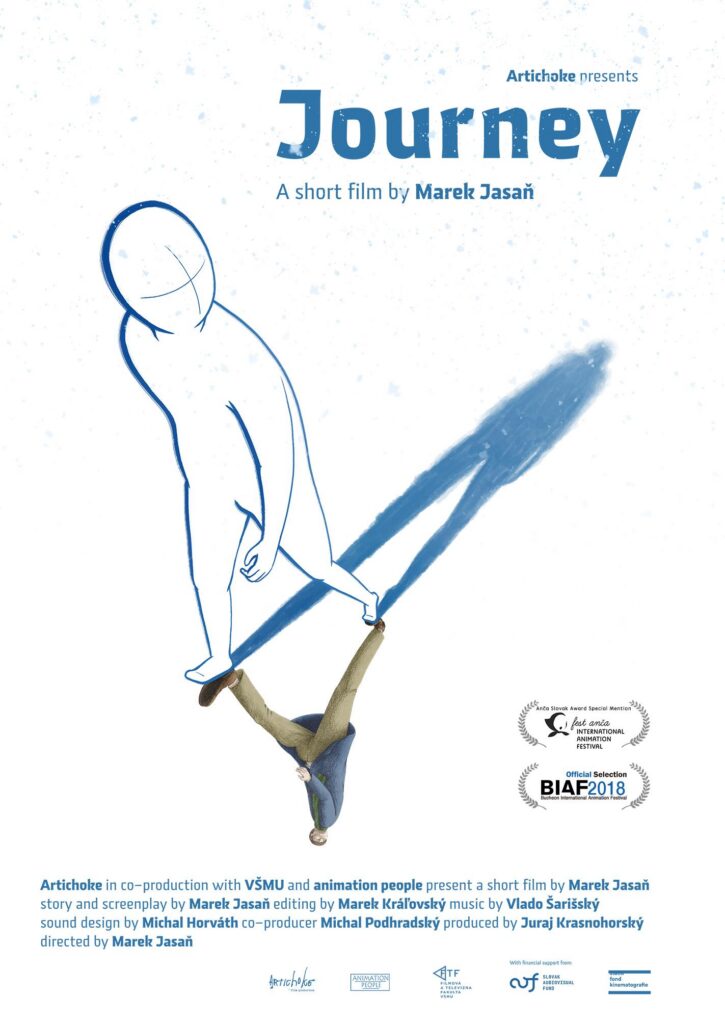
Your graduation film Journey also reflects your own creative process. How did it come about?
Already in my first year studying animation, I had a pretty clear idea of what I wanted my bachelor’s film to be about. I called it Meow. It was about a musician who has a cat but gets so caught up in searching for inspiration that he forgets to feed it.
I could really relate to that. Whenever I focused on studying or improving my skills, I tended to forget about my social life. It’s not that I didn’t have friends, but I was never someone who went out much. I preferred staying at home, drawing or playing computer games.
But once I’d finished that film, I had no idea what to do for my master’s graduation project. I couldn’t just immediately come up with another idea. And eventually, that whole complicated journey of trying to find one gave me the idea to make a film about exactly that. About the creative process itself and the way I see things.
Whenever something catches my attention, I take a little piece of it and try to combine these little fragments to form my own opinions and perspectives, which I then bring into my life or my work.
That’s how Journey came about. It’s not entirely about me, because I think other people can relate to the ideas behind it too. It’s more about how I see people and the way they function. About how things are rarely black and white, and how we constantly influence one another, often without even realising it.
One of the major milestones in your career was working on the stop-motion feature Tony, Shelly and the Magic Light by Filip Pošivač. How did that opportunity come along?
That was a really lucky turning point for me. It all started with the fact that there weren’t many stop-motion animators in Slovakia. Well, there weren’t back then. There might be a few more now. At the time, though, producers didn’t have many options.
They needed a Slovak animator for the co-production, so they first approached Martin Smatana, who turned it down for one reason or another. Then they decided to look for someone who had a good feel for animation and could learn a new technique on the job, basically moving from drawn animation to puppet animation. Somehow, they came across me and got in touch.
How difficult was it to make that transition from drawn animation to puppets?
I’d done one exercise with a plasticine puppet at university, so I wasn’t a complete beginner. But I wouldn’t exactly call that solid proof of my stop-motion skills either.
Filip Pošivač liked my animation work, though, and he shared a view that I’ve since come to agree with. If you have a good feel for animation and timing, the technique itself doesn’t really matter that much. You need to make a mental switch from one approach to another, but if you’re good at drawn animation, you can get used to working with puppets after a few months.
At first, it was definitely a challenge. I was terrible at it. I still remember my “Slávka with cerebral palsy.” It was my first proper attempt at animating a walk cycle in stop-motion, and Slávka looked like she had cerebral palsy. I hadn’t noticed it myself, but our cinematographer Denisa Buranová pointed it out to me.
Gradually, though, I got better. And I actually started to enjoy it quite a lot, considering I’m still doing it today. (Smiles.)

You worked as the lead animator on Daria Kashcheeva’s Electra. But instead of puppets, you were animating real actors. What was that experience like?
It was very interesting, and I enjoyed it a lot. At first, I was a bit worried about how it would work, but in the end, what I enjoyed most was exactly the thing I had no experience with.
When you’re animating an actor, they simply can’t stay perfectly still in the position you’ve put them in. You position them, adjust their arm, but in the two seconds it takes you to walk back to the camera, their arm has already moved.
It was the complete opposite of the precision I’m used to working with, or at least trying to achieve. But that was exactly what made it enjoyable. It pushed me out of my comfort zone of precise animation, or at least my idea of what precise animation should be.
I also enjoyed adapting to the actors and their different personalities. Some like to joke around during animation, while others are more serious. Some will do absolutely anything you ask them to, while others have their own conditions if they’re not happy with what you’re doing.
When I’m working with puppets, I can leave one in exactly the same position for an entire lunch break, even for an hour. You can’t do that with a real actor. They can only keep going for about three hours, so every shot has to move much faster.
Experiences like that make you realise that just because things aren’t going exactly your way doesn’t automatically mean they’re going wrong.
Puppets obviously have different limitations compared to real actors. How do you make them express emotions?
In stop-motion puppet animation, it’s not just about the animation itself. The visual design is equally important, especially what the puppet actually allows the animator to do.
If you have enough different mouth shapes that can be swapped throughout the film, you have many more possibilities for expressing emotions. But if you’ve only got one mouth shape and two eyelid positions, there’s only so much you can do. You must rely much more on the character’s body language.
Maybe that’s also why emotions in puppet animation are sometimes so exaggerated. You simply can’t capture all those subtle little details. When someone is sad or slightly worried and their forehead wrinkles just a little, that’s not something you can easily reproduce with a puppet.
So you need to have different facial expressions prepared in advance that you can switch between. Or you work with the eyebrows, which can help establish basic emotions. And sometimes you just have to communicate everything through the body.
Basically, if the face isn’t designed to do it, you must rely more on physical movement. Or on dialogue and the atmosphere created by the sound designer. (Smiles.)
I imagine it’s quite the opposite with real actors.
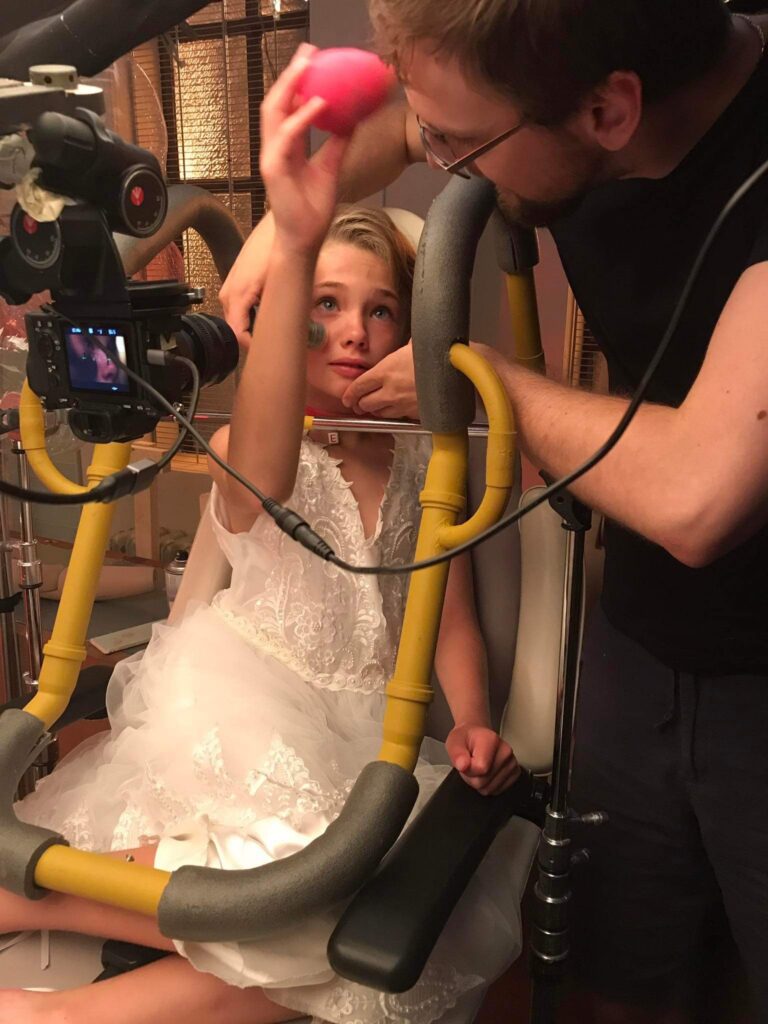
Exactly. With Electra, for example, we faced a completely different problem. Actors are obviously very good at using facial expressions, but in a normal film shoot, they only need to hold an emotion for a particular take, usually three to ten seconds. I needed them to maintain that same expression for two hours.
For example, when we needed Zuzana Stivínová to express anger, she had to get herself back into that emotional state after every single photograph. I watched her on the monitor, and the moment she reached the expression I needed; I had to quickly take the picture. It wasn’t easy at all.
Zuzana Stivínová was actually very good at getting into the right emotional state, but some actors found it a little more difficult.
You also worked on Mária Kralovič’s short film Tourists, which has won several festival awards. What do these kinds of successes mean to you?
Quite often, nothing. (Laughs.) I don’t mean that in a bad way. Of course, it’s nice to tell your family and friends to watch a film you’ve worked on, especially when it’s won an award. But at the end of the day, it’s just another line on your CV.
I think awards matter most professionally. When you’ve worked on a successful film that travels to festivals and wins awards, it can help you find your next job.
And if I work with a director who enjoys working with me and is happy with what I’ve done, that can open the door to collaborating again on future projects.
So I see a film’s success as a kind of confirmation that I’ve done my job well, but also as proof that I’ve been part of something worthwhile.

As a stop-motion animator, you spend a lot of time in a studio under carefully controlled lighting conditions. Don’t you miss the sun?
Well, yes. I do.
What does a typical working day actually look like for you?
I think an animator’s day is pretty boring. I absolutely love my job, but from the outside, it must look incredibly dull.
I come to work, spend eight hours working on a single set, moving a puppet’s arms and legs. And by the end of the day, I’ve made maybe three or four seconds of film. I don’t think there’s anything particularly exciting about that.
When people visit the studio, they’re amazed by the sets, the puppets, and the whole world we’ve created. They watch a little bit of animation and they’re fascinated. But nobody actually stays to watch you work, because the process itself is incredibly boring.
When you spend your days breaking movement down into individual frames, does it change the way you observe people in everyday life?
Not consciously, but sometimes I catch myself watching people. It’s not even so much their movement. It’s more about how they look.
I find it fascinating to observe people’s facial features. How big someone’s nose is, whether they have protruding teeth or an overbite.
Or when someone has a very symmetrical face, I start wondering what exactly makes it look so symmetrical. Sometimes I even compare people to animals. I might think someone has the face of a Doberman, or looks a bit like a rat. We all look different, and I find it interesting to notice these things. I guess it has something to do with the fact that I used to draw portraits.
I don’t do that anymore, but maybe it’s something that’s stayed in my head. I still pay more attention to people’s faces.
And what about movement itself?
I don’t think so. Not yet, anyway. I haven’t developed that particular obsession. (Smiles.)
I mainly pay attention to movement when I’m struggling with something in animation. When I need to show a particular action and figure out how it actually works in real life. For example, if someone is getting up from the ground, I’ll watch which leg they move first, where they put their hand, how they shift their body weight, whether the movement is fast or slow, all those little details.
Sometimes I also watch how people sit in cafés or on buses, what their posture looks like. Because even when a director tells me that a character isn’t supposed to do anything, that never really means they’re doing absolutely nothing.
I can’t just leave a still image of a puppet on screen. A puppet always has to feel alive. That’s what brings animation to life.
So I try to pay more attention to these little details, both in myself and in other people, and find the right balance between movement and stillness. Personally, I find animating a character who’s standing still much more difficult than animating one who’s moving. It’s fun, but it’s also a little bit of hell.

Animation is an incredibly slow process. What kind of personality do you need to spend several days working on just a few seconds of film and still enjoy it?
Patience, obviously. That’s the first thing. You simply have to accept that everything is going to take a long time. But I also think you genuinely have to enjoy the process.
And I still do. Even though it takes ages to see the final result, there’s something really satisfying about spending an entire day working on something, playing it back, and suddenly seeing that it’s alive. That alone makes me happy.
And then, when the director or someone else from the team comes over, watches it and goes, “Awww!”, that feels pretty good too. Especially when you spend your days working in the dark.
You’re currently working on another stop-motion feature by Kristina Dufková, Wish It! (previously About Dreams). What can you tell us about the project?
I don’t think it’s any secret that it’s going to be a film for children. It’s about dreams, as the original title suggests, and it’s aimed at a younger audience than Living Large. There are three of us animators working on it, so that’s basically what I’ll be doing for the next two years.
Artificial intelligence is already changing many creative professions. But putting all that aside, do you feel you’re exactly where you’re supposed to be in life?
Yes, I do. As a kid, I went to all sorts of after-school classes. Dance, art, drama. And now I realise that when you put all those things together, that’s basically animation. So I guess, without even knowing it, I was always heading towards what I’m doing today.
Check out Marek Jasaň and his portfolio here: