Piotr Chmielewski about CRAB
“It’s not a vegan propaganda film”
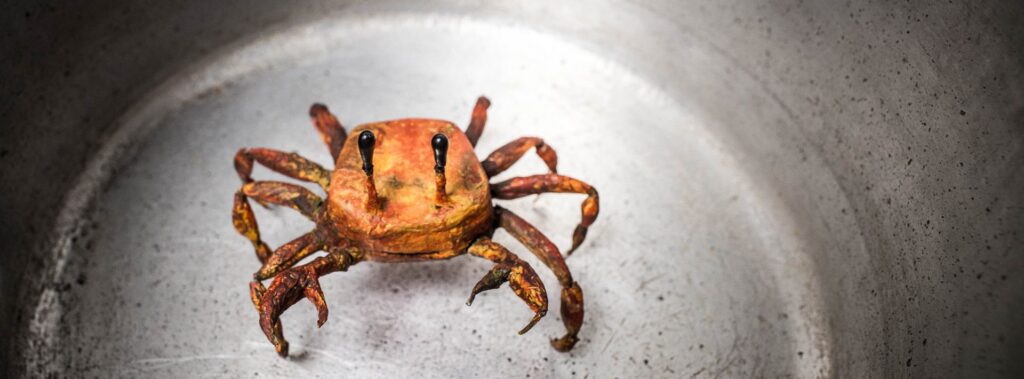
The pitch Piotr Chmielewski gave in Trebon at the 2018 CEE Animation Forum (back then still called the Visegrad Animation Forum) was remarkably disarming: “I don’t know anything about animation, I don’t know how to make a film, but I have this idea…” Yet there must have been something in his performance that convinced the audience – was it the power of his idea or just those big innocent eyes? – and that caused his pitch to be crowned with an award. Now there is CRAB, a story in which we look through the eyes of a mollusc that finds itself in a very particular place: in the galley of a ship, ready to be cooked.
One of the myths in animation is that two of the hardest things to animate are: water and animals with many legs. You decided to make an underwater film with a multi-legged main character.
Piotr Chmielewski: For Paulina Szewczyk, our Head of Animation, not even eight legs were a challenge – she can do much more than that! And we found several solutions to minimise the amount of computer effects in the animation of the water. Recreating the elements is something that I really like about stop-motion; it was great fun.
Tomasz Sobczak (DoP): We also did ‘fire’, which is even more difficult to animate than water.
The animation looks a bit gritty, back to the basics of stop-motion.
Chmielewski: That is the main charm and magic of this technique. I want the audience to see that all this is handmade, with the use of real, unpolished materials.
I imagine you, sitting in front of an aquarium for days.
Chmielewski: I did my research, watching crab clips on YouTube. I went to the Berlin Zoo to observe the kind of movements they make. And I tried to put myself inside a crab’s head – we can only imagine how that will be, but this is my interpretation of how crabs will see and hear the world.
All film long, we stay close to the main character and watch through his eyes, which are not more than two little balls on antennas.
Sobczak: The crab’s perspective was defined by the use of wide lenses. A camera lens strongly resembles the human eye. In the animal world, predators in general have a long focal lens, while prey usually have a wide focal lens.
Chmielewski: The mouth can move a little bit, and that’s all. Even with a minimum of facial expression, you can still read the emotions from the crab’s body language.
Which brings us to the subject of eyes. How many times a week do you get the compliment that you have remarkable eyes?
Chmielewski: My mother once told me a few times. That’s about it.
No eyes without ears! To empathise with the crab, the ears are almost as important.
Piotr Kubiak (Sound): Piotr found it important to use original sounds that we created ourselves, instead of finding them in a sound library. And he forbade the use of dead animals, not even for foley purposes. For a fish slapping its tail in the frying pan, we couldn’t use a dead fish, so we used a banana instead. Bananas were allowed!
What did you use for the sound of bubbling water?
Kubiak: Bubbles! The problem was with the synchronisation. After we recorded the bubbles, I uploaded those sounds in my sampler and then onto a keyboard. Whenever we needed bubbles, I recreated them through the keys of the piano. At first we thought that was funny, but we needed so many of them that after a while I got totally grumpy with Piotr.
There is one particular sound that sent shivers down my spine. The film starts vaguely with a crab crawling around, and then suddenly… the striking of a match. That’s when you know we’re in a horror movie.
Chmielewski: We create tension, but there isn’t much brutality to be seen in CRAB. It’s not a vegan propaganda film. It’s all about taking the perspective of the crab, not about making people feel guilty about eating it. Being inside the crab’s head for eight minutes creates a certain empathy – you imagine how it would feel to be a different kind of being.
Your pitch at the Forum in 2018 also brought together part of this team…
Kubiak: Piotr’s pitch made a deep impression; the crowd seemed to totally believe in his project and everyone wanted to get him on board. I offered him five days in my Polish sound studio as an award, and my producer Wojciech Leszczynski offered him to produce the animation. CEE has been a crucial element in the creation of this film.
Interview conducted by Gert Hermans for ECFA Journal.