Silja Saarepuu about THE TURNIP
“We were cool in our underground hideout”
Root vegetables may not be the most elegant nor sexy of all characters, but the title character in THE TURNIP looks beautiful. While the roots are teeming with hungry insects, a farming family tries with all their might to harvest the crop. Silja Saarepuu (Estonia) was one of the two directors working on this animated folktale.
You succeeded in turning an ordinary turnip into a majestic vegetable!
Silja Saarepuu: That was quite easy, as the turnip didn’t need much animation. But there was a whole world of creatures around it, making the turnip come to life. When planning this film, I went to the countryside and planted a row of turnips, but they didn’t grow very big; they looked more like potatoes.
Why a turnip?
Saarepuu: During lockdown, when everybody was about to go crazy, co-director Piret Sigus invited me to her house and told me she was planning to film a funny story with her kids, something silly about a turnip. I thought the material was so strong that we should send the kids out to play and make the film ourselves.
The film depicts both a world above the ground and one underground.
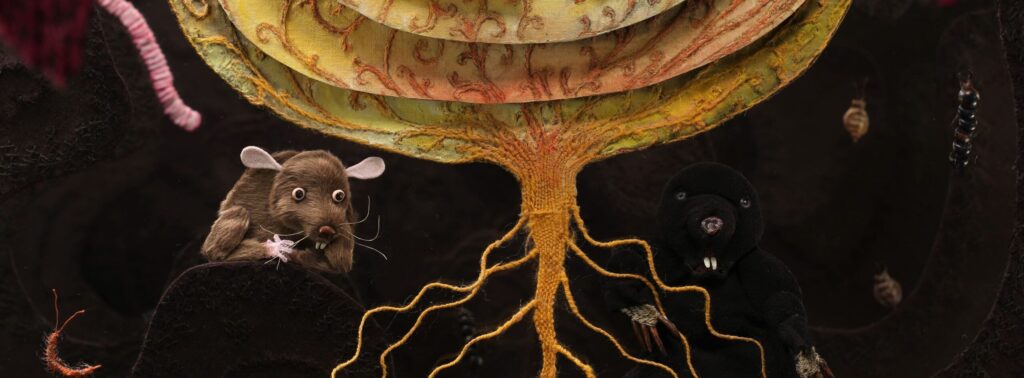
Saarepuu: Underground is the real world, for which we used vivid, colourful visuals. The world above is like ‘the other side’, animated in not much more than contours. Our story focuses on what happens underground where vegetables are growing.
Therefore you had to imagine how life underground would look like, how creatures move and behave.
Saarepuu: That was easy, as our small studio is located underground. When we wanted to find out about certain aspects, we just lifted our heads and looked through the ground window at what was going on there. That was so comfortable. Last summer it was hot as hell, but underground it was fresh; we had to wear woollen socks. Sometimes we quickly warmed ourselves up in the sun before going back to work. While everybody was complaining about the heat, we were cool in our underground hideout.
This turnip causes a rivalry between both worlds.
Saarepuu: The film is based on a folktale, in which the mouse joins the crowd above and helps them pull out the turnip. In our story his role is less outspoken – he is kind of a trickster between two worlds, feeling at home on both sides. In any case you see that all unity falls apart when one element in the group turns its back towards the others.
You stay true to the folktale universe.
Saarepuu: Our independent cut-out animation studio Animailm has already made two films based on folktales, for which we stayed true to specific locations and traditions. We know this story as a Slavic tale, so we went to a region in East Estonia near Lake Peipsi where lives a community of old ‘believers’ from Russian origin, who fled their country in the 18th century during the Church reformation. They have kept many of their traditions alive and we used the embroidered patterns of their clothing in all our decorations, both in the world above as in the insect world.
But in the background there is a car, to prove that the story is contemporary?
Saarepuu: What you think is a car, is actually a “karakatitsa”, also typical for that region. It is something which is constructed from a car, but when putting big tractor wheels underneath, this vehicle allows the local fishermen to drive over the ice on the frozen lake. It’s a detail that might be recognised by an Estonian audience as typical for the Lake Peipsi region.
The film was made by two directors, you and Piret Sigus.
Saarepuu: Piret wrote the first story; from there we worked together on the script and the design. While I focussed more on the characters, Piret designed the vegetables and the patterns in the soil. Together we made hundreds of drawings, Piret did the sewing, and Marili Sokk joined the team as animator, but the studio was so small that only one person could work there at a time. For the embroideries we got help from friends, and we found a group of retired ladies who embroidered the grass and some flowers above the ground.
How do you fit in the Estonian animation tradition?
Saarepuu: Estonian animation is flourishing, with studios both big and small. We are kind of outsiders but we do well in festivals; there were many selections and several awards.
Interview conducted by Gert Hermans for ECFA Journal.