A Portrait of Human Nature, as Drawn by Croatian Animation from 1969 to 2023

While diversity in both technical and topical preoccupations might well be the only easily discernible characteristic of contemporary Croatian animation, some common denominators – and with them the open-ended continuity with world-renowned Zagreb School of Animated Film – can still be established. One of the preferred subjects has traditionally been human nature, as shaped first by the quite specific Central European “between East and West” Cold War position and general pacifist-humanist sensibilities, and more recently by a sense of alienation, the inability to form lasting intimate relationships, and the tearing of the social fabric.
During this nearly six-decade-long period, attitudes towards individualism have perhaps experienced the most profound change. Once an alternative to unifying collectivism, self-entitled potentates, and a narrow-mined society, it is nowadays treated as a symptom of loneliness, uprootedness, and an incapacity to connect. Nastier aspects of human character, such as greed, selfishness, aggressiveness, and an appetite for mass behaviour marked by conformity and exclusiveness have, on the other hand, remained a constant. While all this may sound a bit dreary, humour has, luckily, remained a staple of Croatian authors irrespective of their age. More often than not non-verbal (gag-based), satirical, and dark (so called “gallows humour”), comedy permeates Croatian animation from its inception to this very day.
Techniques employed by filmmakers screened in this programme also reveal a fascinating anomaly in Croatian animated history. Globally celebrated for its limited modernist (non-realistic) cel animation, Croatia (unlike, for example, Czechoslovakia or Slovenia) previously had almost no puppet-film tradition to speak of. After a series of 13 puppet films made under the auspices of Zora Film in the late 1950s–early 1960s (some of them coproduced with Czechoslovak studios and authors, others with contributions by the Slovenian Saša Dobrila), the technique mostly vanished from the country’s animation history (with one notable exception: the films of Zlatko Bourek) until it resurfaced in the 2000s as one of the most accomplished approaches to the medium. Master puppeteers such as Ivana Volda (née Bošnjak), Thomas Volda (formerly Johnson) (Imbued Life) and Lea Vidaković (Family Portrait) are today rightfully counted among the leading animators overall.
Unsurprisingly, hand-drawn animation also went through a significant transformation, not least due to the introduction of tablets and digitally-assisted phrasing. From Daniel Šuljić’s minimalist black-and-white Cake made in 1998 – which, although produced using oil on glass, possessed strong graphical qualities still comparable to the Zagreb School – to Chintis Lundgren’s Life with Herman H. Rott (2015), Jelena Oroz’s Two for Two (2018), and Kata Gugić’s Cockpera (2020), the colour palette became not only more vivid and bright, but also generally shifted towards pastel tones, while both movement and character design drifted significantly apart from their celebrated forerunners. At the same time, relations with – and the symbology of – nature and animals also shifted in the process.
The oldest film in this selection is Nedeljko Dragić’s undisputed masterpiece Passing Days from 1969, the olden days of Zagreb School. According to popular rumour “robbed of” an Academy Award nomination by an envy-motivated “failure to apply”, Passing Days demonstrates arguably the most accomplished author of the Zagreb School’s second generation at his prime. In Passing Days Dragić utilizes the “small man” (“everyman / common man”) motif so dear to Zagreb School filmmakers in a more ambitious way, marked by pronounced symbolical elements that erode the nominally humorous “slice of life” narrative through sequencing metaphorically rich associations. The situations in which the protagonist finds himself are variations on the absurdity of the contemporary human condition. They explore human contact, ranging from menacingly crowded living spaces, oppressive institutions, and constant violations of private space, to unfaithful marriage and an irresistible, yet often grotesque, corporeality. Dragić, furthermore, elevates “whiteness” to an active participant in the narrative – an agent that releases and swallows back all sorts of things and characters, which appear only briefly to serve their typified function before disappearing back into oblivion. The film ends with a conspicuously common trope of Dragić’s oeuvre – the descent into madness, serving as a condemnation of the maladies previously displayed in the film: alienation, repression, authoritarianism, ill-advised relationships, politicians, media, commercial and political propaganda – basically anything that interferes with the everyman’s peace.
No less masterful is Borivoj Dovniković Bordo’s Learning to Walk (1978). The film advocates personal independence, featuring a protagonist bombarded with unsolicited and conflicting advice on how to walk by a series of typified strangers. Initially conciliatory and accepting even contradictory suggestions, the protagonist becomes a walking Frankenstein. Ultimately, echoing the slogan “be yourself!” – popular in Central Europe and often associated with national independence movements – he discards all their advice. Regardless of the author’s personal viewpoint, Bordo’s variant of the “small man” has been interpreted both as a symbol of Yugoslavia’s independent, defiantly autonomous stance on the global stage, and as emblematic of a traditionally discreet national resistance to an oppressive regime. Typical of Bordo’s preference for characterology, psychology, and interpersonal relations in depiction of everyday life, Learning to Walk focuses on a single, highly conceptual, and even a bit absurd situation populated by morally dubious characters (such as the soldier, one of Bordo’s favourite targets). Graphically, the film is distinguished by a lack of detail typical of the author’s background in caricature, especially notable in the complete absence of scenery (reduced to just one color: ochre). The characters are round, soft, and simple, moving within a single shot. Movement, gag, and music thus play crucial roles in sustaining the rhythm. Bordo’s films are also habitually marked by small ruptures of the fourth wall, such as a character’s bewildered, defeated, or defiant gaze into the audience. Learning to Walk is no exception.

Jumping twenty years closer to our time, we encounter the aforementioned Cake by Daniel Šuljić – a study in bourgeois hypocrisy, moral degradation, and disintegration of manners under the pressure of primal selfishness and jealousy. Gathered around a feast and the eponymous dessert that requires either equal or unequal splitting, initially considerate and selfless citizens soon resort to dirty tricks and finally descend into bloody anarchy, thus embodying the failure of the social contract. Aside from being reminiscent of earlier Cold War allegories such as Dušan Vukotić’s Piccolo (itself intertextually pointing to McLaren’s Neighbours), Cake also underlines an archetypal scene of Croatian cinema in general – that of a gathering around the dining table, during which much is said, almost nothing is heard, and certain emotional secrets are revealed.
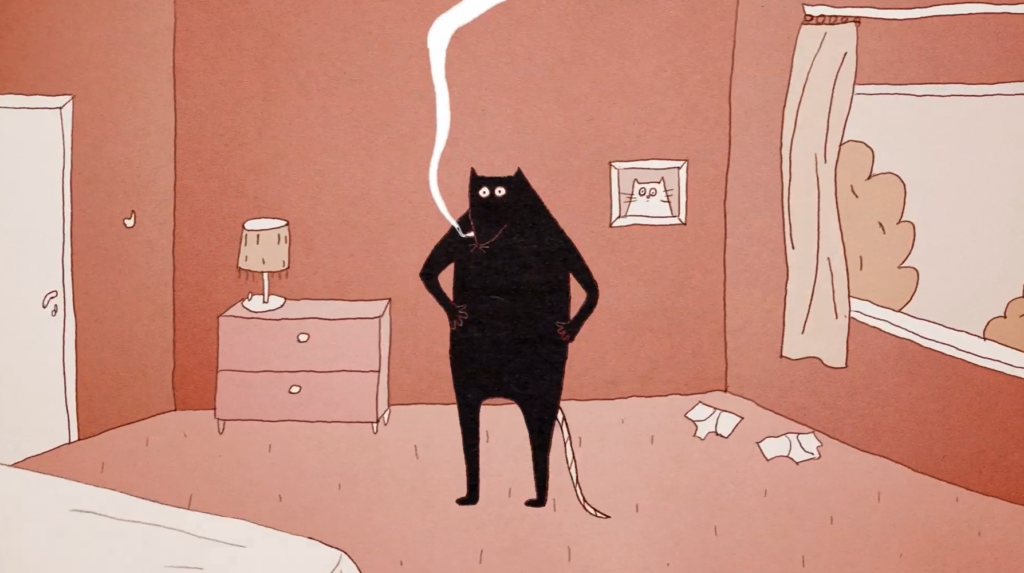
Although the Croatian public was – especially through works of Priit and Olga Pärn – anything but unfamiliar with Estonian animation, the appearance of Chintis Lundgren in the early 2010s still presented a breath of fresh air – one that circulated equally strong through characterization, design, and humour. Her Life with Herman H. Rott (2015), one of her works with a shared character design and narrative “universe”, swept annual awards and garnered wide sympathy for its tongue-in-cheek, down-to-Earth portrayal of a careless, untidy, hard-drinking, hard-smoking, hard-rocking bad boy character who attracts a polar opposite: an obsessively and oppressively clean cat. A modern take on screwball comedy and romance, as well as a commentary on “match-made-in-hell” relationships, the film was soon followed by spiritual sequels, which were among the first in Croatian animation to affirm (in a similarly playful and grounded fashion) queer subjects and characters.
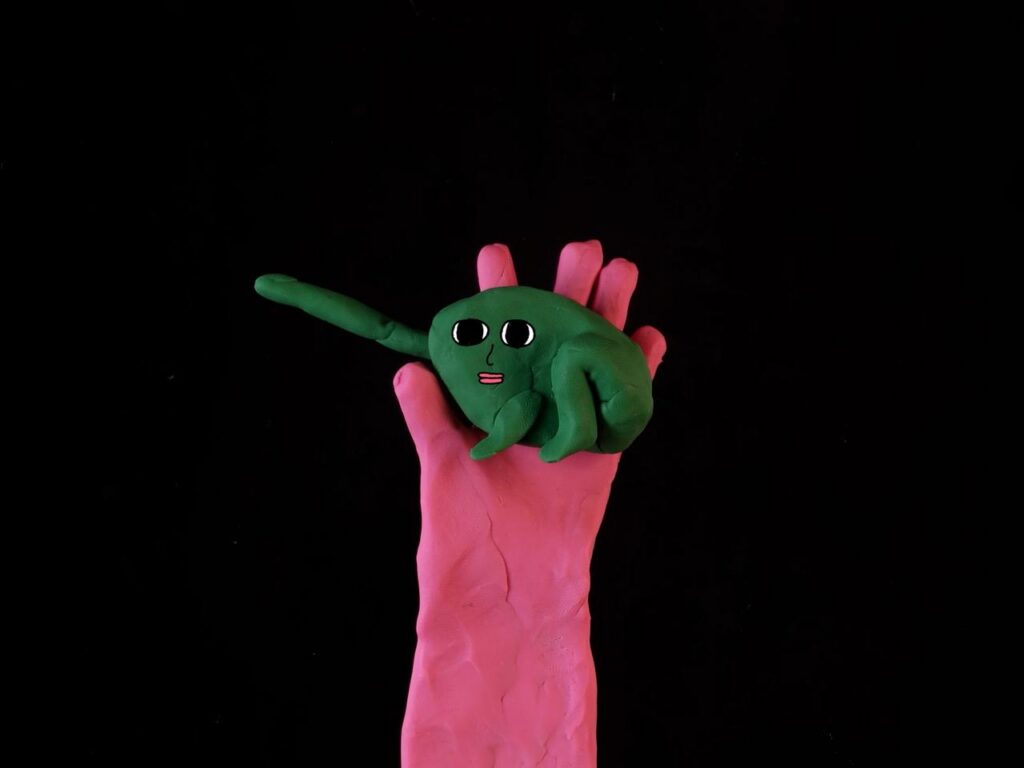
Throughout the 2010s Jelena Oroz was another fresh voice, gradually forming an equally unique 2D style that was at the same time poetical, clean, synaesthetic, and wacky. Her first professional, semi-autobiographical film Two for Two (2018), also dedicated to the theme of relationship, marked the culmination of the first phase of her career. Intensely tactile, intimate, and metamorphic, based on duality, the study of human interspace, and the subtle movement of characters both fragile and strong, Two for Two is equally emotional and thought-provoking, cosy and slightly unsettling, sweet-and-sour film. Oroz reflects on blankness and numbness, possessiveness, loss of empathy, egoism, and self-victimisation that emerge once a relationship is fully established – all through the metaphor of bunnies and assorted objects stemming from the common household. As befits the duality and defamiliarization on which it is based, Two for Two is best described by the oxymoron “tense meditation”.

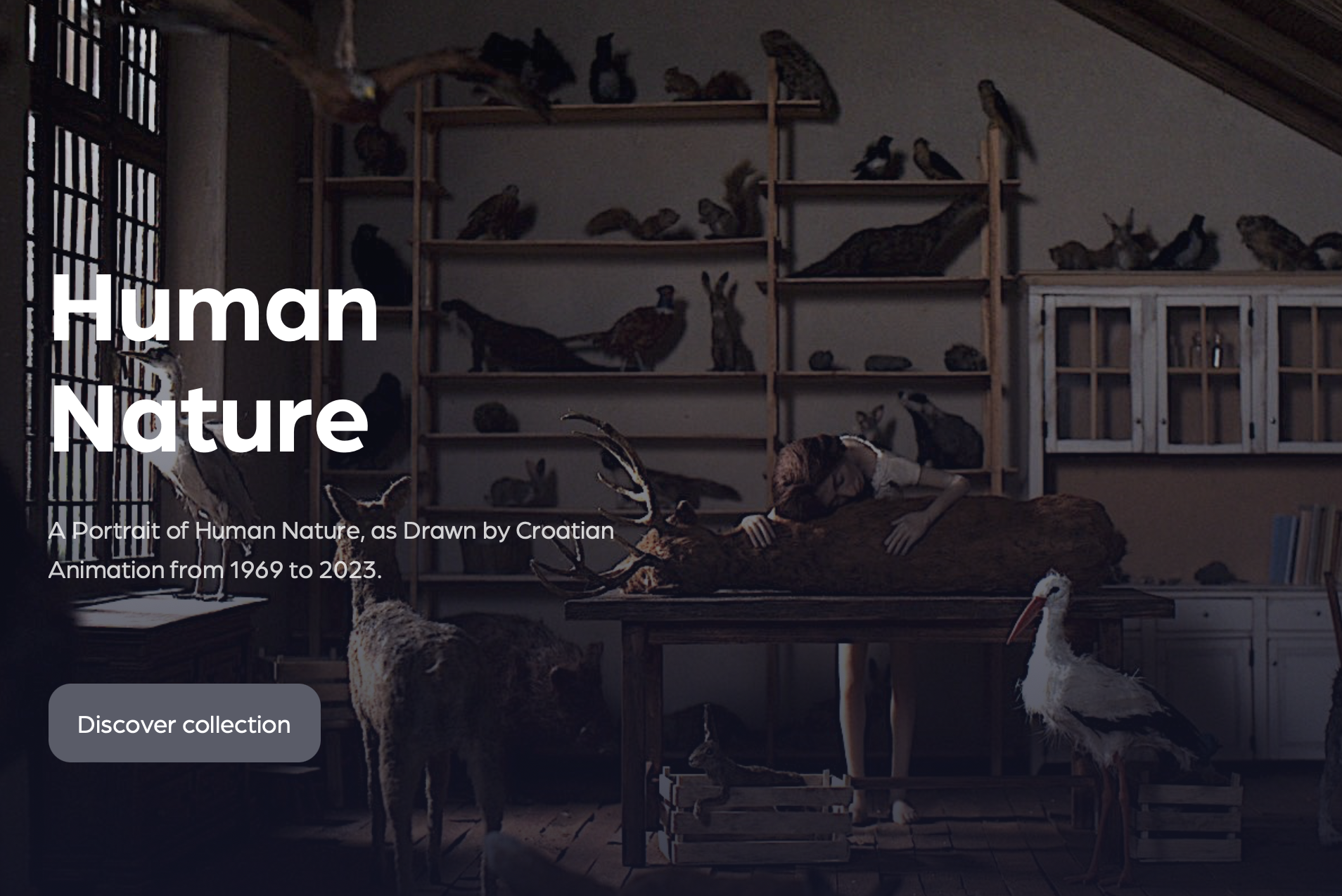
After the warmly received Simulacra from 2014, the creative partnership between Ivana and Thomas Volda produced Imbued Life (2019), yet another strong case in support of Croatia’s rejuvenated puppet film, which caught the eye of selectors in Annecy, Oberhausen and Zagreb. Immersed in a rich and estranged atmosphere marked by a fantastical premise and surreal, oneiric causality, the film – about a woman’s taxidermic reconnection with nature’s vital energy – functions as both psychological mystery and meta-cinematic play. Laboriously made and beautifully illuminated sets, models that repositioned back in their natural context convey strong haptic impressions, as well as proficiency in mixed media (the film is not solely made with puppets) were certainly among the strongest recommendations for the pair’s subsequent involvement with Ted-Ed documentaries. Although no animals were harmed in the process of making Imbued Life, the immediacy of Voldas’ work still warrants a fair warning to particularly sensitive viewers.

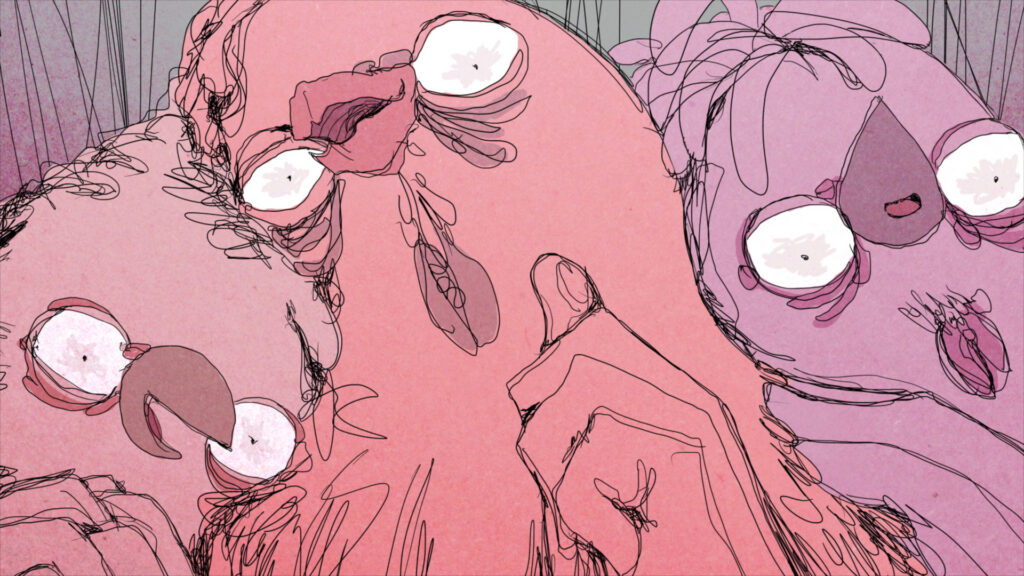
A 2D animated opera buffa inspired by an Aesop’s fable, Cockpera (2020) by Kata Gugić – screened at Clermont-Ferrand, Ottawa, Palm Springs, Animafest, and others – revolves around a startling depiction of a singing cockfight. As is typical for fables, this modern take also speaks more of humans (nominally serving as deus ex machina, but in reality omnipresent through personification and anthropomorphization) than of animals. There is, of course, something to be said about the possible connotations lying behind the word denoting rooster, but far more interesting is the way in which Gugić (assisted by Vjeran Šalamon’s music and sound design) performs a persiflage of operatic conventions (soprano = the girl, tenor = desires the girl, baritone = stands between soprano and tenor) with subtle irony. Gugić’s drawing style, marked by twisted, untidy lines and shades of pink, is equally striking, whether in facial expressions, effects such as puffing, or movement, contributing both to comic effect and to the clarity of a metaphor aimed at all-too-human lust, envy, smugness, and coquetry.
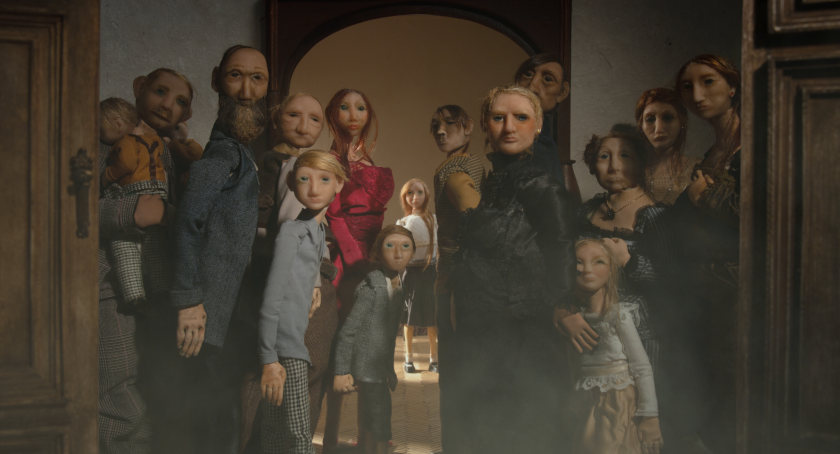
Finally, Lea Vidaković – in animation circles known primarily for her puppet films (although also engaged with expanded cinema and installations) – takes us back into the history of Central Europe, to the last days of the Austro-Hungarian Empire. Since the Habsburg era is today most often evoked through bourgeois kitsch nostalgia, set in opposition to the supposed profanation of both Yugoslavias and the independent nation-state, it provides an apt context for the darkly humorous, socio-critical, and psychological vivisection of Family Portrait (2023). Indeed, in this work, whose approach bares some resemblance to Haneke (or, for that matter, Bernhard or Ibsen), family relations are probed through an external (yet still familial) invasion of privacy in order to reveal, on the one hand, middle-class ennui, and on the other voraciousness and concupiscence unrestricted by morals or taboos. In this way, Family Portrait becomes a somewhat misanthropic epitaph – less to Austria-Hungary, and more to the notion of the traditional bourgeois family and its supposed moral code. Visually inspired by a house in Horgoš and itself meticulously constructed, Family Portrait also rivals Imbued Life in its set and character design, cinematography and haptic suggestion.
Silvestar Mileta