Valentína Hučková – Pioneering Sustainable Animation in Central & Eastern Europe
As the animation industry increasingly faces its environmental responsibilities, CEE Animation is elevating the region’s role in leading sustainable practice. This summer saw the launch of the international Green Animation Guide (PDF) at Annecy—a resource originally developed in France (2023 via Ecoprod) and expanded in 2025 for global application. It includes over 60 fact sheets and 150 actionable steps addressing everything from energy-efficient infrastructure and streamlined workflows to greener mobility, waste management, and eco-conscious storytelling.
Complementing this framework, Polish studio MOMAKIN, renowned for organizing the Animarkt Stop Motion Forum in Łódź, the largest market and educational event dedicated to stop-motion puppet animation, released the Stop Motion Green Guide by StopMoLab in 2023. This guide defines the essential principles of environmentally responsible stop-motion production and promotes the development of common European eco-standards in the medium.
In March 2025, the CEE Animation Conference GO! 2025 in Nova Gorica–Gorizia, part of the European Capital of Culture programme, brought together over 100 professionals from film funds, producer associations, and creative studios across more than 20 European countries. Discussions centred on the future of sustainable production in animation and the creation of a new co-development support mechanism for ambitious projects.
In parallel, industry experts explored a model for a Joint Co-development Mechanism aimed at addressing funding gaps for animated series, feature films, and high-budget shorts. The proposed structure would operate on a membership basis, ensuring transparency, reciprocity, and active participation from all partners in the selection process. A Recommendation Paper is currently being prepared to outline this approach and advocate for its integration into national and regional funding programmes.
On the environmental sustainability front, a new working group led by Ecoprod, Green Film and Cineregio developed a position statement calling for guidelines that address environmental, social, and economic aspects across the animation value chain. CEE Animation co-signed the Statement for European Sustainability Standards in Animation, which calls to help establish voluntary, verifiable, and scalable environmental criteria for animation studios. The draft criteria, currently being developed by industry and sustainability experts, are slated for public consultation and beta testing by the end of 2025. This initiative is foundational for preventing greenwashing and providing funders with credible benchmarks as studios begin to adopt green practices. The Green Animation Working Group are meeting regularly to share best practices and review the common standards for the animation industry.
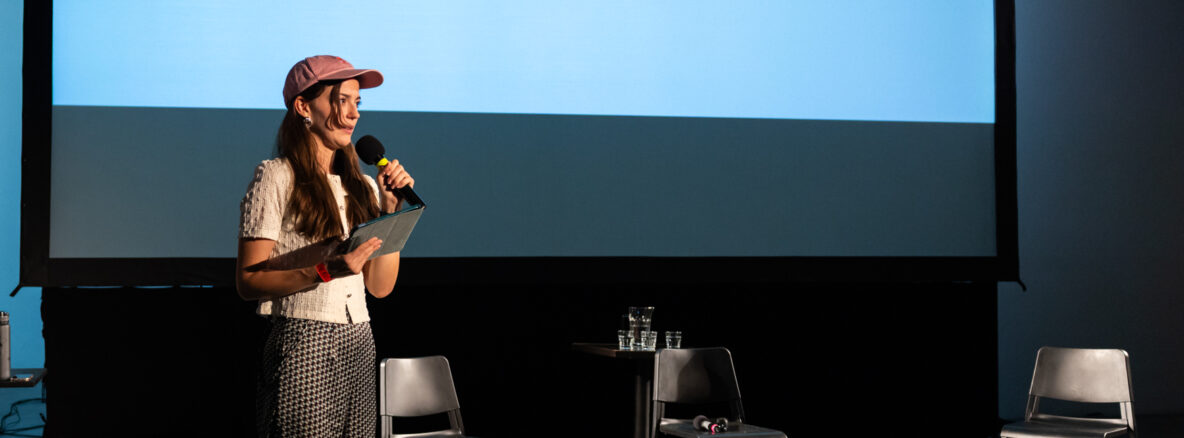
Valentína Hučková, CEE Animation’s newly appointed Sustainability Manager, is spearheading internal practical green measures, and serving as a CEE Animation delegate in the international Green Animation Working Group, and as an industry advisor in the Green Animation Expert Working Group. Having graduated Animation and Film in the United Kingdom, she divides her career between creative work and advising film, TV, animation productions and festivals on carbon footprint reduction strategies.
Valentína, How has your own journey—from creating your student film “Patrick in Town” to consulting on green production—shaped the way you approach this role?
I graduated animation and filmmaking in the United Kingdom, as I considered them the ideal medium to convey difficult and important messages in an approachable way. In the graduation film “Patrick in Town”, which we co-created and co-directed with my classmate and great friend Eszter Sándor, a talented creative from Hungary, we wanted to show that environmental responsibility and activism can be portrayed in a fun and light way to lure the audience with humour and convey these crucial themes. I first came into contact with the topic of sustainable or “green” film production thanks to BAFTA albert initiatives during my studies in the UK. As I was studying my MA, I became more focused on the production side of animation and the wider film, art and culture industry, considering the direct environmental impact such as materials, energy use, and waste management. I jumped into all available training and courses on this topic, and soon landed my first jobs on Slovak and international productions aiming for green production certifications.
The role of a Sustainability consultant in the creative industry is a mixture of many jobs – one should be well-versed in the industry itself, know the processes in depth, understand each department, role and responsibility to make expert suggestions to improve any already existing structures. One must also be well-educated on the topics of environmental sustainability, the climate crisis, the industry’s direct impact, but also the latest technologies, innovations, and scientific developments related to both the environment and creative production. Last but not least, one should be a people person and a diplomatic communicator able to handle escalated situations – there is often an unwillingness to change the old and comfortable ways of working in the face of what seems like just a trend (which it’s obviously not).
Over these few years, I learned to approach this role from a wider perspective, focusing on systemic and behavioural change, customising each production’s approach and aiming for a positive compound effect.
What would you say is the most difficult about making an animated film in a sustainable way?
We often believe the animation and film industry has a negligible impact when compared to global transport, energy or manufacturing industries. I think it’s often the most difficult to change our ways of thinking. In the beginning, the animation creator or studio should set their environmental goals and analyse their potential impact way before production starts. This requires people, knowledge and time to plan ahead. As long as we can adapt our way of thinking and working to consider the planet as a pillar of our work (as compared to only profit, for example), it shouldn’t be too difficult to make animated films more sustainably. Any step forward counts.
The Green Animation Guide lays out ambitious and important objectives. What practical steps are most immediately actionable for studios in the CEE region?
It’s really important to localise regional strategies and set realistic goals for what is possible given the local infrastructure, since one solution does not fit all. There is always the danger that when we try to create universal objectives for a sustainable transition that someone will get left behind due to a lack of equal opportunities/infrastructure. In the CEE region, the availability of decarbonised energy is widely different, same with low-carbon transport networks. Digital footprints and energy consumption depend on hardware efficiency and pipeline efficiency; cloud-based rendering is difficult to trace, so these are all things we need to pay attention to. For stop-motion, based on physical materials, waste management differs not only between countries but even within regions and districts. So it’s really important that we (studios and creators in the CEE region) work together and become actively engaged in the creation of these international guidelines and standards, otherwise we risk being left behind and losing co-production attractiveness.
As a Sustainability Manager, what immediate priorities are you focusing on—both internally for CEE Animation, and externally in the broader industry ecosystem?
As with every production, to work with an organisation, production company, or festival comes down to understanding our impact first – analysing the existing processes and sources of CO2e emissions in a business-as-usual scenario, and then assessing and targeting the greatest sources of environmental impact and suggesting options for improvement. Of course, I’d like to go for the big catch first, but in practice, it’s often easier to transform the small and less impactful processes, educate the team and get people on board along the way, before moving on to the big fish. Often, I’m lucky that the people I work with are really on the same page, sometimes, not so much. That either comes down to finance, such as needing to invest in the future return of greener solutions, sometimes the bigger transitions require more capacities or time. But we can always find a middle way, since a compromise is comparably better to inactivity.
My own priority is that everyone (not just in the animation industry) develops an idea of the importance of environmentally sustainable action. The climate crisis is well beyond the tipping point, and all we can do now is take action, no time for future promises anymore. So in my opinion, we really mustn’t compare ourselves or our industry to those “more” heavy polluters. Now is the time to make changes, each their own. Power comes in numbers and I think that although we need to demand changes on a systemic level, at the same time we should each contribute our own. Understanding our impact is crucial in being able to improve.
How do you see the specific needs of stop-motion productions differing from those of 2D or 3D animation when it comes to sustainability?
2D and 3D animation share the most similarities through the digital pipelines, rendering, asset management, and hardware efficiency, affecting energy usage. Stop-motion stands apart with its use of physical space and materials for puppets, sets and props, likening it more to live-action film processes, often using single-use or hard-to-recycle materials like derivates of plastics, foam, glue, paints etc. which makes waste management, reuse, and sourcing sustainable/biodegradable materials central issues. 2D and 3D animation generate digital waste through redundant files, or hardware obsolescence such as inefficient equipment or outdated storage devices. So e-waste recycling and efficient data management are the main concerns. Comparing energy demand, stop-motion requires long shooting times under lights and cameras, so energy use is concentrated in studio lighting, climate control, and camera rigs, whereas 2D and especially 3D animation require powerful hardware and render farms, which can consume massive amounts of energy and need sustainable IT practices. Put simply, stop-motion sustainability challenges are analog while 2D and 3D animation are mostly digital.
The Statement for European Sustainability Standards in Animation will enter a public consultation phase later in 2025. How will industry professionals and the wider public be able to give feedback?
There is an Expert working group led by Ecoprod and Green Film, which I am a part of, preparing the draft of the Sustainability Standards in Animation right now. In late autumn, these should be shared with the Green Animation Working group to provide feedback. The Green Animation Working Group is made up of diverse international stakeholders from the animation industry – producers, film commissions, representatives of associations and so on. The joining of CEE Animation marked an important step for the presence and representation of our region, which is often underrepresented due to the low-production capacity of most countries. We hope that by actively participating as CEE Animation, we can advocate for our diverse needs and also provide the animation industry stakeholders from our region the information they need to give feedback on these proposed Standards. Interested professionals are still welcome to join by signing the Statement and expressing an interest in further cooperation on this link – (https://tally.so/r/31yKGO ) The wider public will find out about this through news and press releases.
Are there any emerging green technologies or materials that you think could be game changers for animation in the next five years?
Of course! When I was working on the Ecoprod Green Animation Guide, it became clear to me that the most promising changes in sustainability are coming from both technology and materials. AI is the elephant in the room (which I am not an expert in), and although it can help in many ways within the pipeline, the energy usage creates an enormous environmental impact, so it’s very important to study up on the latest research. For digital workflows, real-time rendering can help animators preview and finalize scenes almost instantly, which could speed up the process and decrease energy consumption, but on the other hand, rendering iterations or duplicates increases this. So paying attention to asset management, naming and avoiding surplus is important. Another shift is happening with servers that integrate heat recovery and efficient cooling systems. Rendering and storage will always demand a lot of power, but if that infrastructure is tied to renewable energy and/or its excess heat is reused for local communities, then animation can align much more closely with sustainable goals. In the Green Animation Guide (especially in the original French version) you can find a lot of inspirational cases on how studios “green” their infrastructure.
On the stop-motion side, the innovation seems to lie in biodegradable and recyclable materials and modularity for future reuse (and the willingness to plan this way). Puppets, props, and sets are still often made from plastics and foams that are difficult to recycle, but the development of plant-based foams, natural binders, and eco-friendly 3D printing opens up a new circular approach.
So I see the next five years being shaped by the combination of greener IT infrastructure and eco-friendly stop-motion materials. Together, this could significantly redefine what sustainable animation looks like.
If you were to produce a new animated short today with sustainability as a core value, which material would you choose and what would be the theme? Perhaps you’re already working on it?
That’s a great question, it was actually a topic I was researching during my studies – how animation is a great tool for inspiring positive social change through communicating these topics like environmental sustainability, environmental justice and showing viewers alternative lifestyles. I find that the younger generations are the most aware of the current situation, and are often suffering the psychological impacts of these uncertain times such as climate anxiety or climate depression. I would like my films to offer reassurance and inspiration to this generation, while also communicating to older generations and showing that action is important. I found my way to overcome (or at least supress) feelings of climate depression myself through what I believe is my source of contribution towards a greener future (for now, focusing on the production side).
But I have a few animation shorts in development in my pocket, focused on inspiring positive action without being didactic. I truly love the tactile nature of stop-motion, so a few of those are to be made of a mix of strictly upcycled waste materials, or natural biodegradable ones.
You can watch Valentína’s film recommendations touching the subject of ecology here: