
Interview with Lucie Sunková about SUZIE IN THE GARDENS
Lucie Sunková, a screenwriter, artist, director, and animator, was born in 1974 in Prague. She graduated from the Václav Hollar Art School and later from the Department of Animated Creation at FAMU. Known for her work in the animation technique of oil painting on glass, Sunková’s films often explore deep themes through vivid and symbolic visuals. She is also a writer and illustrator of children’s books. Her latest animated film, SUZIE IN THE GARDENS, which had its world premiere at the 2022 Berlinale, is a heartfelt exploration of a child’s imagination and fears, blending mystery and humor in a way that resonates with both children and adults. In this interview, Lucie discusses the challenges of working with glass animation, the importance of a strong script, and the emotional depth she strives to achieve in her work.
Lucie, your recent work marks a shift toward more dynamic and symbolic artistic stylizations. What inspired you to make a film for children, and how did you choose the story of SUZIE IN THE GARDENS?
After finishing my previous animated film L’ARBRE, I was thinking about how to continue and in which way to further develop the animation technology of painting on glass. I was very attracted by bolder dynamics and more symbolic artistic stylization. So far, I have focused mainly on films aimed at adult viewers, but have also met, surprisingly, the interest of children (e.g. the Children’s Jury Award at the Fantoche festival in Switzerland). I was inspired by their enthusiasm for this type of animation. That’s why I thought that I would make a film for children, but one that would interest adults as well. When I got my hands on the book by writer Jana Šrámková and artist Andrea Tachezy SUZIE IN THE GARDENS, it immediately occurred to me that I was looking for just such a story. It adopts with kindness and without any cheesiness a child’s vision of the world and contains mystery and humor. I wanted to get into the mindset of a little girl, to understand children’s imagination and fears, and at the same time evoke in adult viewers memories of moments and situations that they themselves experienced in childhood.
You’ve spoken about the technical challenges of animating on glass. Could you tell us more about those difficulties and how you overcome them?
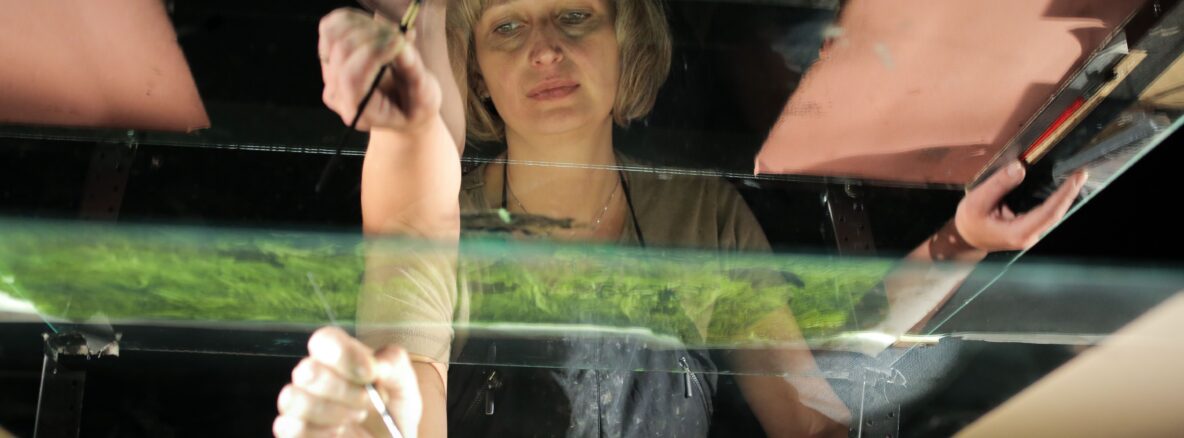
Animating a painting on glass always involves the problem of properly lighting the multi-plane animation table. So that the painting does not cast shadows and does not create reflections. I paint on three glass plates and often deal with various problems caused by the reflection of the paint and also the dust that is created on the glass in the process. With the help of the cameraman, we have so far always solved everything and fine-tuned minor adjustments in image post-production (this is a big relief).
Additional difficulties are sometimes brought about by international co-production, which today is necessary for the financing of short films. It is important to choose the right strategy for work that can be done remotely and to choose your colleagues well. I’ve been lucky that I’ve always managed to do that with my projects.
As an artist, how do you balance the artistic side of a film with its storytelling? What’s the most important element for you when creating a film?
The basis of everything is a good script. Quality content can be forgiven even for minor execution errors, but a perfect visual spectacle without content usually doesn’t work. Since I am an artist by origin, I was mainly interested in the artistic side of the film at the beginning, but as time goes by, I attach more and more importance to the preparation of the script. For me, it is essential that the film has a message, and for that you need to use the right means. I try to think more and more about the composition of the shots, because for good communication with the viewer, the shots themselves are important, but more important is the relationship between them, and also their rhythm.
But the most important thing is to put into work both my brain and heart, and to work on projects that I believe in with all my soul.
What do you hope audiences take away from your work, especially with a project like SUZIE IN THE GARDENS?
With SUZIE IN THE GARDENS, I hope the audience, both children and adults, find a sense of wonder and mystery. I want to capture the way children see the world — full of questions, fears, and moments of joy — while also reflecting on those childhood experiences through the lens of adulthood. The film’s message is one of connection, imagination, and the importance of exploring the world around us. I hope that, through my work, viewers are encouraged to reconnect with that sense of curiosity and innocence that we often lose as we grow older.